What is Distortion?
Distortion is the blanket term given to overdrive, distortion, crunch, fuzz, and other similar effects. It is characterised by the 'clipping' of the audio wave peaks and troughs. Distortion was originally achieved by pushing the amplifier beyond its design limits - turning the gain way up so that the amplifier is trying to output a voltage higher than it is capable of. The voltage output then 'saturates' and clips the tops and bottoms of the signal to this maximum output level.
Initially the tubes in a tube (or valve) amplifier were overdriven to distort the signal, but most amplifiers manufactured today use semiconductor (solid-state) devices to amplify the signal, and myriad dedicated distortion effects pedals exist to distort the signal with much more flexibility and control than just whacking the gain up to its maximum. There will always be a debate about whether or not tube distortion is superior to the solid-state distortion we frequently see today, and really it all comes down to personal preference. Tubes aren't so commonplace these days and are often expensive and tricky to work into a small circuit like the ones we're looking at, so whilst tube distortion pedals do exist, we'll focus on solid-state pedals like the MXR Distortion+.
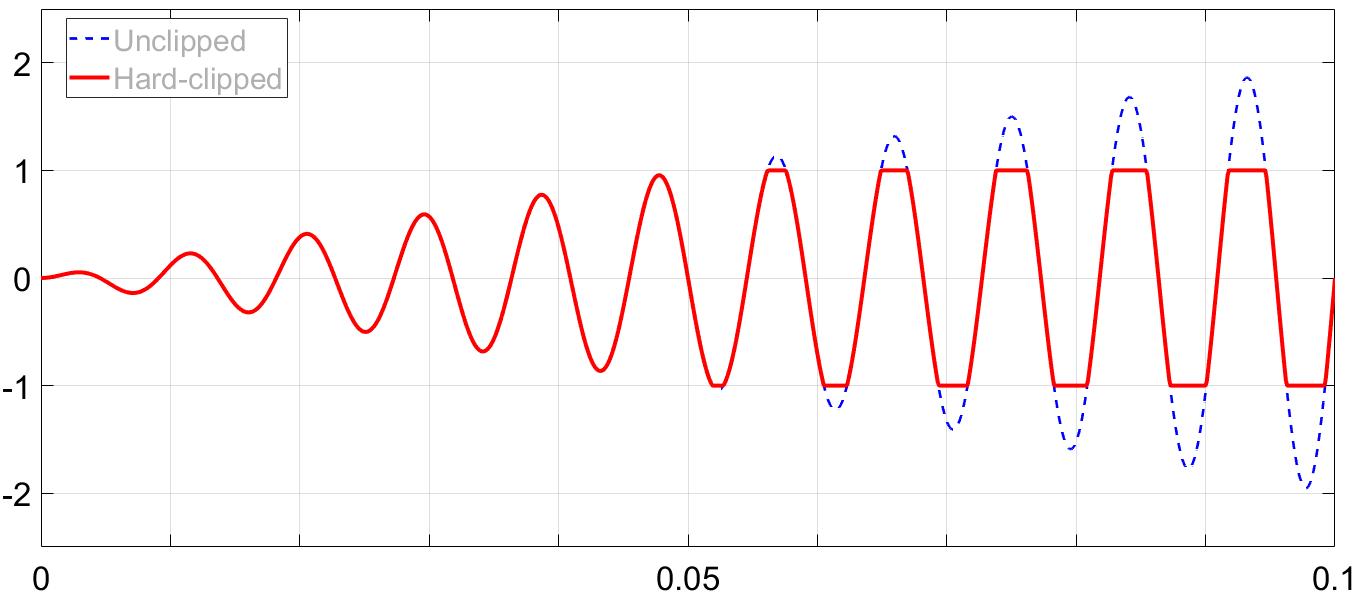
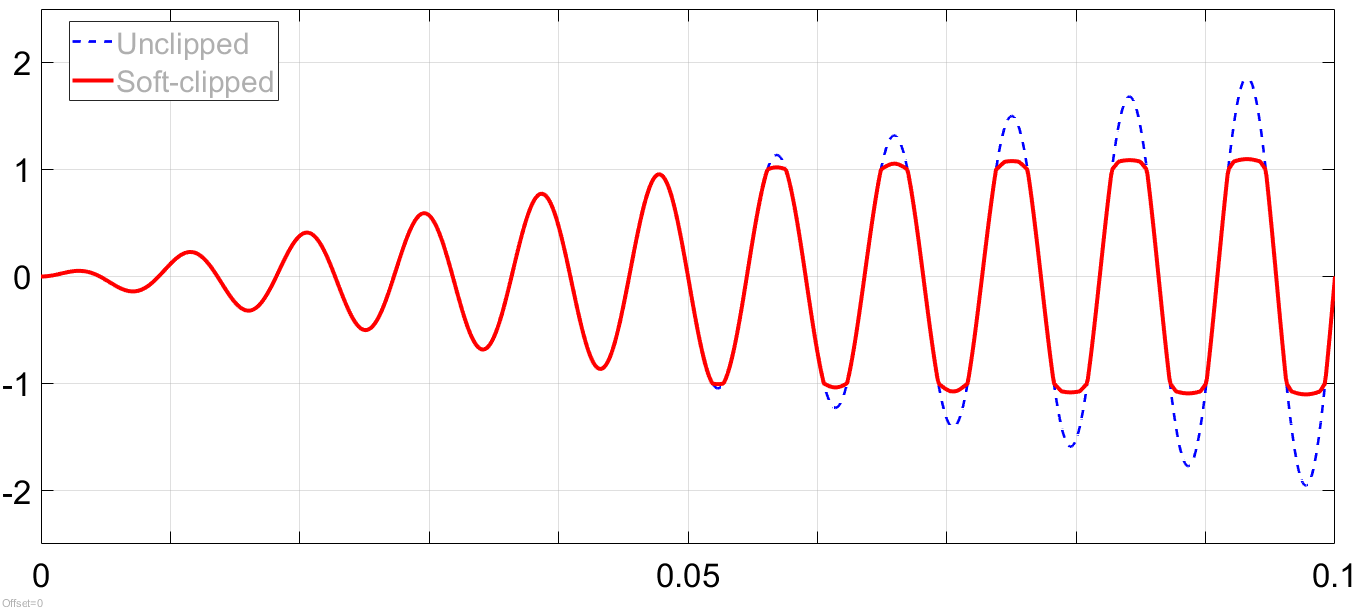
Clipping can either be hard (typical of solid-state circuits) or soft (typical of tube circuits). We can see the (admittedly quite subtle) difference in the below plots and audio clips.
Let's investigate hard- and soft-clipping, plus an unclipped wave for reference:
No cliping
Hard clipping
Soft clipping
The peak amplitude of each of those recordings is approximately the same, though you'll notice the distortion tracks seem a lot louder. If you want a technical explanation for this: the truncation of the peaks means the total area underneath the audio waveform is greater, and so there is a greater power output from the amplifier.
You might also recognise that the shape of the clipped waveform is looking a bit more like a square wave, and this tells us that clipping the waveforms has introduced higher frequency harmonics. The hard-clipped waveform has sharper 'corners', telling us it has more high frequency content than the other two. If you listen to the two clipped waveforms, you might be able to tell that the hard-clipped waveform sounds 'sharper' than the soft-clipped one, and this is because of those extra high-frequency harmonics.
Other than the type of clipping, distortion can also be characterised by other factors.
The clipping threshold determines the maximum amplitude of the waveform before it is clipped.
Clipping can either be symmetric or asymmetric. Asymmetric clipping means that the clipping threshold is
different on the positive and negative half cycles, while symmetric clipping has the same clipping threshold for both half
cycles of the waveform.